Student Innovation | Technology and Health
23
Apr
Posted by: Antillean Adventist University
Category:
News
No Comments
Eighth Grade Student Designs AI-Powered Lenses for Alzheimer’s Patients
Lunahia Ramos, 13, created a working prototype of AI-powered facial recognition glasses to help her great-grandmother and thousands of patients suffering from memory loss.
When Lunahia Ramos received a call from her great-grandmother and the woman didn’t recognize her on the other end of the line, something stirred within her. Instead of resigning herself to the silent pain that accompanies Alzheimer’s—that disease that erases names, faces, and memories—Luna, as her family and teachers call her, decided to do something about it. She was 12 years old.
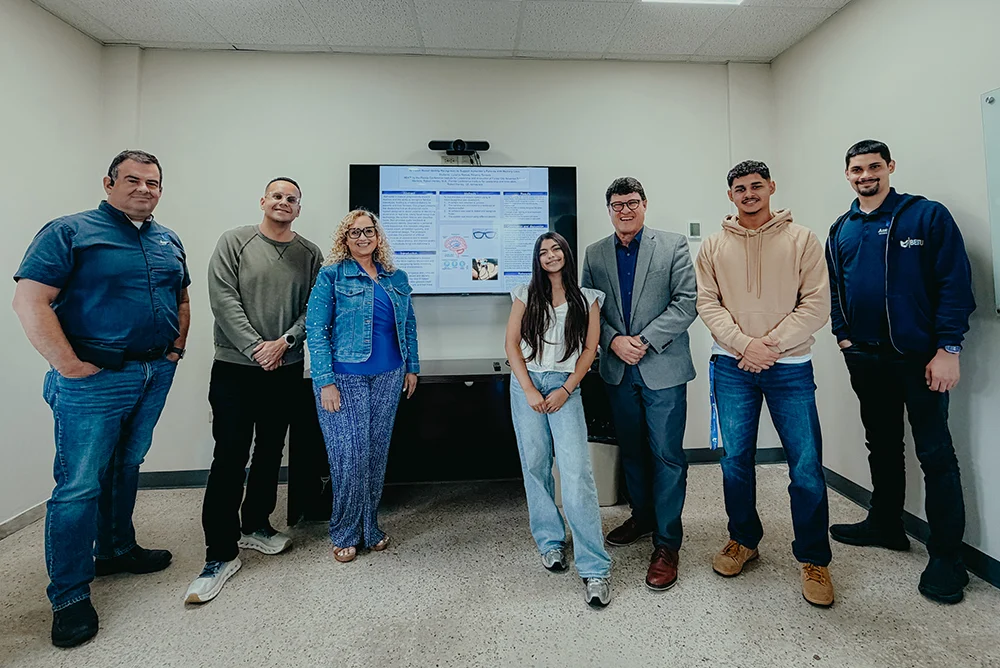
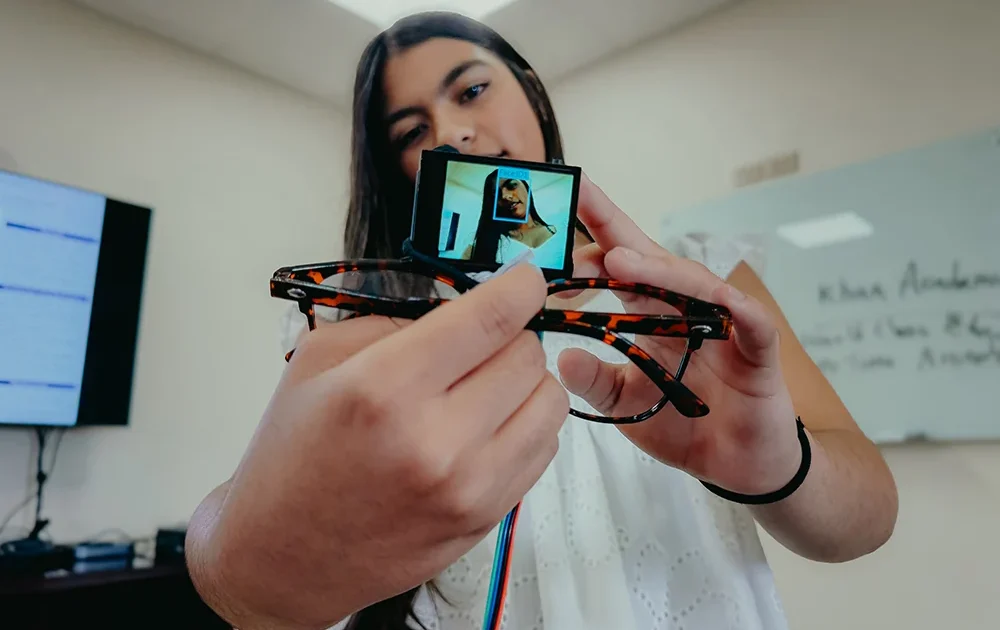
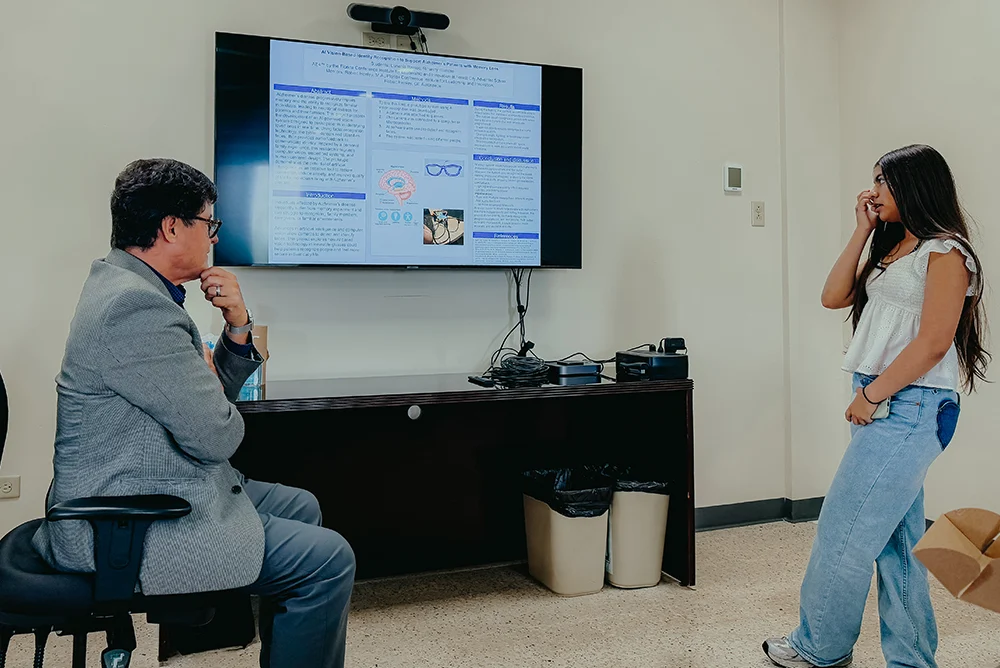
Today, at 13 years old and in eighth grade at Forest City Adventist School, this young Puerto Rican woman presented a functional prototype of smart glasses to the administration and academics of the Antillean Adventist University: the AI Face Identity Glasses, a facial recognition system based on artificial intelligence designed to help Alzheimer’s patients identify their loved ones in real time.
“I wanted her to know who I was when she saw me. That was the moment the idea was born.”
— Lunahia Ramos, eighth grade student, Forest City Adventist School
The project
The system developed by Luna integrates a camera connected to conventional glasses, a microcontroller, and artificial intelligence software for facial detection and classification. Upon identifying a person, the device emits an audio message through a small speaker, telling the user who they are looking at: “This is your grandson,” “This is Luna, your great-granddaughter.”
What makes the project even more remarkable is that Luna not only conceived the idea, but also learned to solder electronic components, program in code, debug software errors, and build the physical prototype with her own hands, under the mentorship of Mr. Robert Henley, MA, of the Florida Conference Institute for Leadership and Innovation and GE Aerospace, who guided her through each stage of the research process.
“When I made a mistake, I would get up and ask myself: how do I fix this? I would ask Mr. Henley, and he would tell me what I had done wrong. That’s how I learned,” the student recounted with the ease of someone who already thinks like an engineer.
The science behind sleep
According to the research poster presented by Lunahia Ramos and her project partner Rihanny Romero, Alzheimer’s is a disease that progressively deteriorates memory and the ability to recognize familiar people, generating emotional distress for both patients and their families. The project proposes that computer vision and artificial intelligence technology has the potential to act as an assistive tool to restore these lost connections.
During tests conducted with various members of her family—including her own great-grandmother—the system proved capable of detecting faces and displaying the corresponding information. Luna documented the results with interaction reports that showed how, upon hearing the name through the speaker, the patient reacted with emotional recognition even though she could not recall the name on her own.
The researcher herself acknowledges the limitations of the current system: the initial version only recognized one still image per person and was sensitive to changes in camera angle, lighting, and facial expression. “I need to train the system with more images, add more AI models, and improve accuracy,” Luna admitted with the clarity of a scientist who understands the iterative process of research.
Beyond the glasses
Luna doesn’t stop at glasses. During her presentation, the young woman shared her vision of an integrated health technology ecosystem that would include a smart bracelet capable of replicating the device’s functions, a vital signs monitoring system, medication reminders, geolocated movement notifications, and a mobile application that allows family members to schedule recognition data and set safety limits for the patient.
“I want families to be able to add people, see where they are, and receive reminders like: ‘Your daughter arrives at 3 p.m.’ That way they don’t forget important things,” the student explained, describing her application with the precision of a product designer.
To make the experience more human and less robotic, Luna even integrated the option to record the voices of family members so the device can greet them by name with a familiar voice. “If it were a standard robotic voice, it would be less personal. But if they hear their granddaughter’s voice, that changes everything,” she noted.
“There’s nothing on the market that does this for health. That’s the opportunity.”
— Dr. Edwin Hernandez, UAA President
A seed of innovation in Puerto Rico
Lunahia Ramos’s project is not an isolated case. Forest City Adventist School and the Florida Conference Institute for Leadership and Innovation have embraced an educational model that places students at the center of applied research, allowing them to tackle real-world problems with real-world tools. This approach is producing results that extend far beyond the classroom.
For Luna, the question of her future is already taking shape: “I like both areas, technology and health. I think I can combine them.” And with what she has demonstrated so far, no one in that room had any doubt that she can.